On one occasion, some scribes and Pharisees approached Jesus and asked him for a sign from heaven as if Jesus had not already performed enough miracles. They wanted something more dramatic to know that Jesus was genuine or was the Messiah. Jesus said they were an evil and unfaithful generation, and no sign would be given them except the sign of Jonah (Matt 16:1-4). Of course they didn’t know at that time what Jesus meant. Jonah was in the whale for three days and nights which prefigured Jesus’ three days in the tomb, counting the days inclusively in the Jewish way.
All through the history of the Church some generations have been blessed by signs or miracles from heaven, specifically what we call Eucharistic miracles. (158 Eucharistic Miracles listed by country in the Vatican International Exhibit) In every Mass, the bread changes into the body of Jesus during the consecration and is no longer bread although keeping the appearance of bread and the wine changes into the blood of Jesus and is no longer wine although keeping the appearance of wine. But in a Eucharistic miracle, the bread changes its appearance to look like what a doctor would describe as heart muscular tissue and the wine changes its appearance to look like human blood. While hundreds of these have occurred in the history of the Church, for the past few decades it is now standard practice, whenever one of these miracles occurs, for the local bishop to request a full and complete scientific and medical analysis of the flesh tissue that had been bread and an analysis of the blood.
An Italian cardiologist, Dr. Franco Serafini (in Bologna), has written a fascinating book on these miracles in five locations around the world that have been subjected to medical and scientific examination in recent years. (Dr. Franco Serafini A Cardiologist examines Jesus: the stunning science behind Eucharistic miracles) He travelled to examine the medical notes of the hospital consultants/professors who performed the laboratory tests on these Eucharistic miracles.
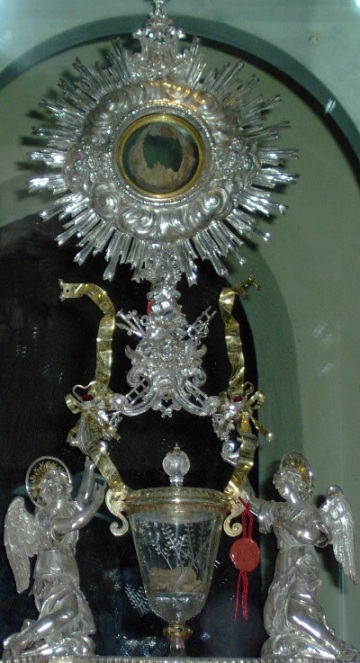 The best known Eucharistic
miracle occurred in Lanciano, Italy, around the year 700. During the
consecration, the bread changed into flesh and the wine changed into
blood. The flesh, and blood now congealed into five blood clots, are
exposed daily for prayer and adoration—the flesh in a monstrance and
the blood in a glass chalice. A first examination was done in 1574
when a further miracle took place—when the blood clots were being
weighed, no matter what way the blood clots were combined together
or on their own, though they are different sizes, they always
weighed the same. It reminds us that receiving just a part of a
consecrated host or receiving only the consecrated host and not
receiving from the chalice, is receiving Jesus completely. Also, it
was not too long after the Reformation, so another miracle was not
unwelcome. In 1971, an examination performed by Dr. Linoli
(University of Siena) discovered the flesh to be heart muscular
tissue. In 1981, a more detailed examination by Dr. Linoli showed
that the flesh was a slice of a human heart, showing some of the
left ventricle, some of the right ventricle, endocardium which is
the lining of the heart, vagus nerve, arteries and veins (Cardiologist
examines Jesus pages 25-26). It was like a cross section of the
heart (Cardiologist examines Jesus p26) so we could say it is
the heart of Jesus or the Sacred Heart.
The best known Eucharistic
miracle occurred in Lanciano, Italy, around the year 700. During the
consecration, the bread changed into flesh and the wine changed into
blood. The flesh, and blood now congealed into five blood clots, are
exposed daily for prayer and adoration—the flesh in a monstrance and
the blood in a glass chalice. A first examination was done in 1574
when a further miracle took place—when the blood clots were being
weighed, no matter what way the blood clots were combined together
or on their own, though they are different sizes, they always
weighed the same. It reminds us that receiving just a part of a
consecrated host or receiving only the consecrated host and not
receiving from the chalice, is receiving Jesus completely. Also, it
was not too long after the Reformation, so another miracle was not
unwelcome. In 1971, an examination performed by Dr. Linoli
(University of Siena) discovered the flesh to be heart muscular
tissue. In 1981, a more detailed examination by Dr. Linoli showed
that the flesh was a slice of a human heart, showing some of the
left ventricle, some of the right ventricle, endocardium which is
the lining of the heart, vagus nerve, arteries and veins (Cardiologist
examines Jesus pages 25-26). It was like a cross section of the
heart (Cardiologist examines Jesus p26) so we could say it is
the heart of Jesus or the Sacred Heart.
Five Eucharistic miracles occurred in Buenos Aires, Argentina, in the 1990s. Hosts were found in a parish church but because of the damage done to them, the priest did not consume them but put them in a container of water (vasculum) in the tabernacle to allow the host to dissolve completely. In such a situation, when the sacred host has dissolved completely in the water, it is no longer Jesus. But instead of the host dissolving in the water as expected, blood clots formed on the host in the water. In another of these miracles in Buenos Aires, flesh tissue was examined by Dr. Zugibe, a cardiologist from New York who was not told what it was. He said,
I am a heart specialist. The heart is my business. This is heart muscle tissue, coming from the left ventricle, near a valvular area. . . This cardiac muscle is inflamed…This person’s heart has been wounded and has suffered a trauma. The blood flow has been compromised…It resembles what I see in road accidents, … or it resembles what I find when someone has received severe blows to the chest. (Cardiologist examines Jesus p46)
The cardiologist had not yet been informed that the specimen came from a Eucharistic miracle.
One very peculiar thing about each of these Eucharistic miracles is that they showed signs of life! One sign of life is the presence of leukocytes, white blood cells, in these miracles. Under normal circumstances, white blood cells are only in living tissue and dissolve when the body dies. They dissolve within an hour outside of the body…..but there were leukocytes, white blood cells, in these Eucharistic miracles which indicates life. But that is not all. The flesh tissue kept in water was among the worst environments to preserve it. When Dr. Zugibe was asked, “How long would these leukocytes survive, if the tissue were set in water?” he responded, “They would dissolve within a few minutes and no longer exist.” At that point he was told the sample came from tissue kept for a month in tap water and for three years in distilled water: he responded “Absolutely incredible! Inexplicable by science!” He was later told it came from a consecrated host. (Cardiologist examines Jesus p47) Another specialist who examined one of the Buenos Aires miracles said that under her microscope it was living tissue (Cardiologist examines Jesus p37) and seemed to be rhythmically beating (Cardiologist examines Jesus p38). Also, a glass slide with a sample of tissue shows a macrophage (white blood cell) digesting adipose (fat tissue) at the time the sample was taken, as would happen in a living organism. Jesus is real and alive in the Eucharist.
Bishop Jorge Bergoglio, who later became Pope Francis, became auxiliary bishop of Buenos Aires around the time the first of these Eucharistic miracles occurred. Later, as Cardinal, he used to go to that parish once a year to sit and pray adoring Jesus in front of the tabernacle containing the Eucharistic miracles. The parish published a card showing then Cardinal Bergoglio seen from behind and turned in prayer toward the tabernacle. He said, “This is the best picture of a bishop I have ever seen: it represents him the way he must be.” (Cardiologist examines Jesus p49)
This is an extremely brief summary of the examinations on Eucharistic miracles in two of the five locations written by the Italian cardiologist, Dr. Serafini, who travelled to see the medical notes recorded by the consultants/professors who examined the samples. (I have also drawn on a documentary on DVD of the Eucharistic miracles in the same five locations: Segni: Miracoli eucaristici with audio and subtitles in many languages, available from libreriadelsanto.it If outside Europe, you need a region-free DVD player to view it.) The heart of Jesus was under stress in each miracle because it was the heart of Jesus undergoing the agony of his passion for us. God, in his mercy, has given us these Eucharistic miracles to prove to us that Jesus really is present in the Eucharist.
© Fr. Tommy Lane 2025
This homily was delivered in a parish in Ireland.
More Homilies for Corpus Christi
Eucharistic Miracles: Tixtla, Sokolka, and Legnica 2026
The Eucharist: the greatest gift 2023
The Real Presence of Jesus in the Eucharist and Eucharistic Miracles
Year A: Meet Jesus in his Real Presence in the Eucharist 2008
Year B: Hungry for Jesus 2024
Jesus’ continuing presence with us in the Eucharist 2021
Year C: Is Jesus in the Eucharist the center of your life? 2007
Related Homilies: Homilies on the Eucharist