When Jesus went up to Galilee after being baptized by John the Baptist, Matthew tells us this passage in Isaiah was fulfilled. Isaiah wrote:
The people who walked in darkness
have
seen a great light;
upon those who dwelt in the land of gloom
a light has shone. (Matt 4:16)
John the evangelist wrote also about Jesus as the light when he wrote that the Word is the light that shines in the darkness, and the darkness has not overcome it (John 1:5). It is not just Matthew or John the evangelist saying Jesus is the light—Jesus himself described himself as the light. In John 8, on the last day of a Jewish festival, Jesus said, “I am the light of the world. Whoever follows me will not walk in darkness, but will have the light of life.” (John 8:12) Jesus didn’t just say he was light—he was practical. The Gospels report Jesus giving sight to people in Galilee—the blind man in Bethsaida (Mark 8:22–26), two blind men in Galilee (Matt 9:27-31), a man who was blind and mute (Matt 12:22), and multiple blind people having their sight restored (Matt 15:30-31) Further south, Jesus gave sight to Bartimaeus in Jericho (Mark 10:46–52, Matt 20:29-34, Luke 18:35-43) and Matthew and John report Jesus healing the blind the temple (Matt 21:14; John 9). When Jesus said he is the light of the world, he was also practical and gave sight to all these people.
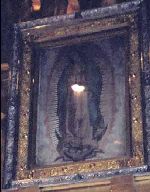
Jesus continues to be practical as we can see
in an incident that is reported to have taken place in the shrine of
Our Lady of Guadalupe. In the image of Our Lady, she is wearing the
black maternity band tied in a ribbon high around her waist and
there is a four-petal flower (Nahui Ollin) on her abdomen indicating
to the Aztec people that she was pregnant carrying Jesus.
 In 2007,
within a week of the municipal council of Mexico City legalized
taking the life of the unborn, an intense light emanated from Our
Lady’s abdomen in the form of an embryo. The light was very white,
pure, and intense, and different from regular lights produced by
flash cameras. It had the form and measurements of an embryo.
Looking at the light more closely showed that it had some areas of
shade, like the characteristics of an
In 2007,
within a week of the municipal council of Mexico City legalized
taking the life of the unborn, an intense light emanated from Our
Lady’s abdomen in the form of an embryo. The light was very white,
pure, and intense, and different from regular lights produced by
flash cameras. It had the form and measurements of an embryo.
Looking at the light more closely showed that it had some areas of
shade, like the characteristics of an
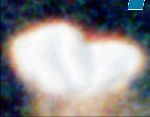 embryo in the womb. Jesus is the light
of world, challenging the darkness of the world. (Permission
received in 2008 from ACIM, Association Catholique des Infirmières, Médecins
et professionnels de la santé, to display the pictures on this website.
I saved a report on the photographic negative
here and
here.)
embryo in the womb. Jesus is the light
of world, challenging the darkness of the world. (Permission
received in 2008 from ACIM, Association Catholique des Infirmières, Médecins
et professionnels de la santé, to display the pictures on this website.
I saved a report on the photographic negative
here and
here.)
Many believe that Jesus also showed himself to
be the light of the world at the moment of his resurrection. The
most studied artifact in the world is the
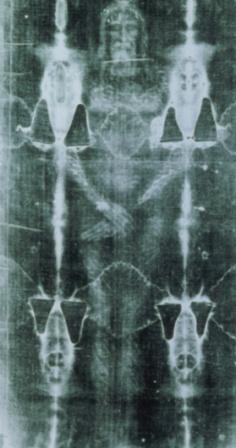 Shroud
of Turin. There is no technology in the world that can produce the
image on it. The image of the crucified man is not paint or ink and
is only on the surface of each fiber of the cloth; it has not
penetrated beyond the surface of the fibers. When photography was
invented, a big shock occurred because when the first photograph was
developed in the dark room, it was like a negative rather than a
photo, with light and dark reversed, and revealed details not
visible to the naked eye. Yet, the cloth is from centuries before
photography was invented. Also, the image indicates how far each
part of the body of crucified man was from the cloth by the
intensity of the image, like a 3-D image. Almost every test on the
cloth is contested both ways by scientists and there is lots of fake
news about it on the internet. But at the end of the day, we have to
come back to where we started: there is no technology in the world
that can produce that image. So what produced the image? The most
common explanation is that it was a burst of light radiation at the
moment of Jesus’ resurrection. It had to have been just the right
amount because if it were not strong
enough it would not have left the image on the cloth and if it were
too strong it would have burned up the cloth. Of course, no one can
say for definite it was the cloth over Jesus in the tomb at the
moment of his resurrection, but perhaps we could apply to it this
famous quote: “for those who believe, no proof is necessary. For
those who don’t believe, no proof is possible.” When visiting it
(May 24, 1998),
Pope John Paul II said, “the imprint left by the tortured body
of the Crucified One, which attests to the tremendous human capacity
for causing pain and death to one’s fellow man, stands as an icon of
the suffering of the innocent in every age.” (§4) He also said, “The
Shroud is an image of God’s love as well as of human sin.” (§5) For
an exposition of the shroud in 2013,
Pope Francis recorded a
video message in which he said, “the Man of the Shroud invites
us to contemplate Jesus of Nazareth.” As we contemplate the shroud,
we contemplate Jesus the light of the world.
Shroud
of Turin. There is no technology in the world that can produce the
image on it. The image of the crucified man is not paint or ink and
is only on the surface of each fiber of the cloth; it has not
penetrated beyond the surface of the fibers. When photography was
invented, a big shock occurred because when the first photograph was
developed in the dark room, it was like a negative rather than a
photo, with light and dark reversed, and revealed details not
visible to the naked eye. Yet, the cloth is from centuries before
photography was invented. Also, the image indicates how far each
part of the body of crucified man was from the cloth by the
intensity of the image, like a 3-D image. Almost every test on the
cloth is contested both ways by scientists and there is lots of fake
news about it on the internet. But at the end of the day, we have to
come back to where we started: there is no technology in the world
that can produce that image. So what produced the image? The most
common explanation is that it was a burst of light radiation at the
moment of Jesus’ resurrection. It had to have been just the right
amount because if it were not strong
enough it would not have left the image on the cloth and if it were
too strong it would have burned up the cloth. Of course, no one can
say for definite it was the cloth over Jesus in the tomb at the
moment of his resurrection, but perhaps we could apply to it this
famous quote: “for those who believe, no proof is necessary. For
those who don’t believe, no proof is possible.” When visiting it
(May 24, 1998),
Pope John Paul II said, “the imprint left by the tortured body
of the Crucified One, which attests to the tremendous human capacity
for causing pain and death to one’s fellow man, stands as an icon of
the suffering of the innocent in every age.” (§4) He also said, “The
Shroud is an image of God’s love as well as of human sin.” (§5) For
an exposition of the shroud in 2013,
Pope Francis recorded a
video message in which he said, “the Man of the Shroud invites
us to contemplate Jesus of Nazareth.” As we contemplate the shroud,
we contemplate Jesus the light of the world.
Jesus is practical. He wants to enlighten every corner of your life. In the second reading today (1 Cor 1), the Corinthians had accepted Jesus but there were a lot of divisions among them as well as loads of other problems as we see in Paul’s letters. They still needed to allow Jesus to enlighten every corner of their lives. Can you allow the light of Jesus to shine on the Corinthian part of your life?
© Fr. Tommy Lane 2026
This homily was delivered in a parish in Ireland.
More Homilies for the Third Sunday Year A
Meeting Jesus in the Gospels 2020
From darkness to the light of Jesus 2017
Come after me: call of the disciples 2014
Leave the boat and build up God’s kingdom
Related Homilies: Homilies on Vocation Homilies on priesthood Jesus’ light
Second Reading: The Church is never my Church but always Jesus’ Church
Sunday of the Word of God: Homilies on Sacred Scripture
stories about vocation